
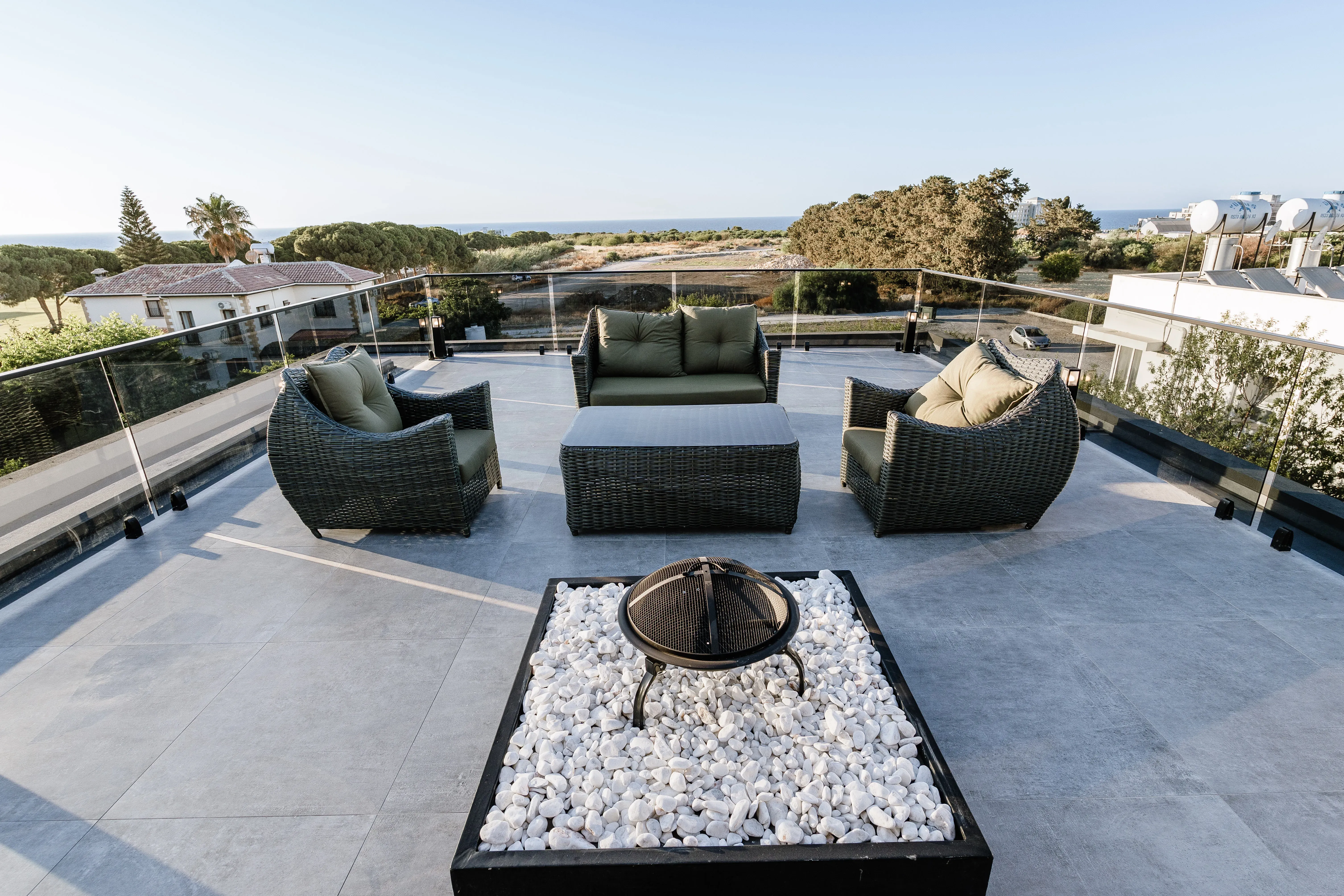
One of the most frequently heard sentences in a Kyrenia sales office is: “We’ll use it for holidays and it will be an investment too.” It sounds sensible — but accepted without question, that sentence can end in a property that serves neither goal fully. Because a holiday home and an investment property are different answers to different questions.
In this article we sharpen the criteria of each goal separately, then give an honest assessment of the hybrid model for those who want to combine them.
The holiday home: you are the yardstick
When choosing a holiday home there is only one jury: you and your family. The criteria follow:
- Feeling and view: What you see over your morning coffee on the balcony matters more than the square metres.
- Closeness to sea and nature: Holiday rhythm turns on the triangle of beach, walks and dinner.
- Comfort features: Private pool, generous terrace, a guest room — what determines the joy of use.
- Ease of upkeep: If it will sit empty part of the year, a managed complex or a reliable maintenance arrangement is essential.
For a holiday home, “will it earn rent?” is secondary; even if you ask it, don’t let the answer pull you away from the main goal.
The investment: tenant and future buyer are the yardstick
For an investment property the jury changes: now tenant demand and the buyer at resale do the talking.
- Location-demand match: Proximity to the centre, the universities or the tourism corridor — it must be clear which demand source the property serves.
- Easy management: For remote ownership, site management, standard layouts and a low maintenance burden are advantages.
- A wide buyer pool: The property that sells fast at exit is the one that appeals to broad demand, not a narrow taste.
- A net calculation: A realistic yield figure after service charges, management and void periods — a calculation, not a promise.
Notice what is absent from this list: the coffee drunk facing the view. The more room emotion gets in an investment decision, the worse the calculation becomes.
The hybrid model: possible — if set up honestly
A few weeks or months of own use, letting for the rest — this model genuinely works in North Cyprus, especially in managed complexes in coastal areas. But with three honest warnings:
- Season clash: The weeks you will want to holiday are the weeks rent is highest. You will concede either income or enjoyment.
- Wear on the home: Tenant use gradually files down the “our home” feeling.
- The cost of double criteria: A property that appeals to both you and tenants is usually “good enough” for both goals — not “excellent” for either.
If you choose the hybrid model, choose it knowingly — disappointment is born of unmanaged expectations.
The decision framework: three questions
- How will I be using this property in 5 years? (Mostly me — or mostly tenants?)
- Who will look after it while it stands empty? (No answer means a managed complex is a must.)
- If I had to sell tomorrow, who would buy it? (The exit scenario is built on the day you buy.)
For the property type, our villa or apartment comparison helps; for the area, our Kyrenia area guide.
The Atason portfolio has an address for both goals
On the holiday-living side, the private-pool Monte Carlo Villas; for investment and hybrid scenarios, Monte Carlo Homes on the Mediterranean shore. In both projects we listen to your goal and tell you honestly which fits — and if neither does, we say that too. Let’s plan a conversation to sharpen your goal.